
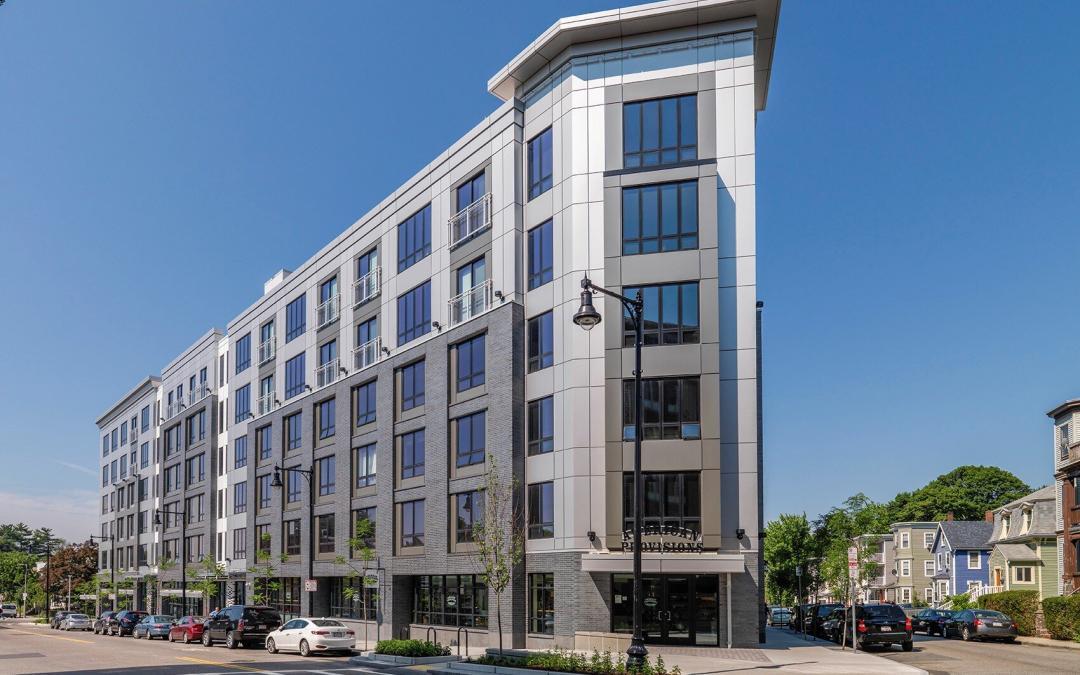
You have closed your takeoff on a large commercial facade, the finish spec reads AAMA 2605 compliant, and the number looks clean. What the spec does not tell you is whether panels produced across three separate coating runs will match each other on the wall, and what it will cost you if they do not. Batch-to-batch color drift is an unpriced contingency that lives between the performance standard and the purchase order.
The Performance Floor Is Not a Color Consistency Guarantee
AAMA 2605 is a durability standard. It governs coating chalk resistance, fade resistance, adhesion and film integrity over a 10-year exterior exposure cycle. What it does not govern is batch-to-batch color repeatability across production runs. A manufacturer can deliver panels that are fully AAMA 2605 compliant and still produce measurable color variation between coil lots or spray batches, because the standard measures long-term performance, not production consistency.
The unit used to express color difference is Delta E, derived from CIE colorimetry methodology. Industry finishing practice generally treats Delta E values above 1.0 as perceptible to the human eye under standard daylight conditions. Values above 2.0 are broadly considered commercially unacceptable on a finished facade, where adjacent panels are viewed simultaneously under the same light source.
The practical consequence for estimators is straightforward: AAMA 2605 compliance is a minimum performance threshold, not a color consistency guarantee. Pricing against it as though it were both is pricing against a standard that was never designed to carry that load. The gap between what the spec requires and what the owner will accept on the wall is where rework cost originates.
Four Production Conditions That Turn Color Variation Into a Change Order
Color drift does not occur randomly. It concentrates in predictable production scenarios, and identifying them before you price is the first step toward quantifying the exposure.
- Large orders fulfilled across multiple production runs, where coil lot changes or batch mixing differences introduce measurable hue or gloss shift between early-delivered and late-delivered panels.
- Replacement panels ordered months after original installation, where the original batch reference is no longer active and the new run is matched by formula rather than by a retained physical standard.
- Field damage repairs on a portion of an elevation, where a single replacement panel or a small re-order sits adjacent to weathered original panels that have shifted slightly from their initial color.
- Projects with phased construction schedules, where panels for Phase 1 and Phase 2 are produced in separate fiscal quarters under different coil inventory.
Fluoropolymer resin-based coatings are formulated for long-term color retention, and that performance record is well established. Resin performance, however, does not eliminate batch-to-batch variation introduced at the pigment dispersion or application stage. The chemistry that protects color over a decade of exterior exposure is a separate variable from the production controls that keep two coating runs consistent with each other at the time of manufacture.
A Documentation-Based Framework for Pricing Finish Drift Risk
Once you have identified which production scenarios apply to your project, you can build a rework cost model from first principles rather than absorbing the risk into general overhead.
- Establish the drift exposure surface. Calculate the total square footage of panels that will be produced across more than one coating run, then identify which elevations are most visually prominent. A color mismatch on a secondary mechanical screen carries a different consequence than the same mismatch on the primary street-facing curtainwall.
- Assign a replacement unit cost. Price the labor and material to remove, reorder and reinstall a single panel, including scaffolding or lift equipment access. That figure becomes your base rework unit for the model.
- Estimate a drift probability factor. Request the manufacturer’s documented color tolerance data expressed in Delta E, covering both within-batch and batch-to-batch variation. If no documentation is provided, treat the absence of data as a risk indicator and apply a higher contingency percentage to reflect the unknown.
- Calculate a contingency line item. Multiply the number of at-risk panels by the replacement unit cost, then apply the probability factor to arrive at a dollar figure that can be carried as a named contingency in the bid, not buried in general overhead where it is invisible to the project team.
Fairview’s factory-applied finish process includes documented color consistency controls, which means estimators working with Vitrabond FR or Vitraplate can request tolerance data as a standard pre-qualification step rather than treating it as an unusual ask. That data point converts an estimated probability factor into a calculated one.
The Documentation Checklist That Separates Priceable Risk From Unknown Risk
Not all finish sources will respond to a documentation request the same way. The following checklist defines what you need before you can price the risk with any confidence.
- A written color tolerance specification expressed in Delta E, covering both within-batch and batch-to-batch variation. A general statement of quality is not a substitute for a stated numeric tolerance.
- Coil lot traceability records showing whether the manufacturer can match a specific production batch for replacement orders placed 12 to 36 months after original delivery.
- A sample retention policy confirming that physical color standards from the original order are archived and available for future comparison, not just formula records.
- Third-party or in-house test reports confirming AAMA 2605 compliance, which establish the performance baseline and give you documentation to attach to the bid file.
AAMA 2605 compliance documentation is a minimum submittal requirement on most commercial facade specifications. Batch traceability records are a separate and additional layer of protection. Estimators who request them independently are not adding bureaucratic friction; they are closing the gap between what the spec requires and what a dispute resolution process will actually need.
How to Write a Finish Tolerance Contingency That Holds Up in a Dispute
A contingency that is not defined precisely enough to trigger cleanly is not a contingency; it is a negotiating position. The following structure gives the allowance a defensible technical basis.
- Name the contingency explicitly in the bid as “finish batch variation allowance” with a dollar value and a defined trigger condition, such as any installed panel measuring Delta E above 1.5 compared to the approved color standard.
- Reference the color measurement method in the contingency language. ASTM D2244 is the standard test method for calculation of color tolerances and color differences from instrumentally measured color coordinates. Citing it converts a visual disagreement into a numeric, documentable finding.
- Specify who performs the measurement and with what instrument. A spectrophotometer reading taken under D65 illuminant conditions is the accepted commercial standard and removes subjectivity from the acceptance decision before a dispute develops.
- Include a remediation scope in the contingency: panel replacement only, or panel replacement plus associated trades such as waterproofing, sealant and inspection, so the dollar figure reflects the full cost event rather than just the panel material.
Using Your Contingency Model to Evaluate Suppliers on Total Cost, Not Unit Price
A rework cost model does more than protect your margin on a single project. It gives you a structured basis for comparing finish sources that goes beyond unit price.
- Apply the model to each finish source you are evaluating. A supplier with a lower unit price but no documented color tolerance data may carry a higher total cost when the contingency is added to the comparison.
- Request the same documentation set from each source and score them on three criteria: Delta E tolerance stated in writing, batch traceability policy and AAMA 2605 compliance documentation.
- Present the comparison to the project team as a total cost analysis. Estimators who frame finish source selection in dollar terms are more likely to influence the decision than those who argue on specification language alone.
- Document the comparison in the bid file. If a lower-cost source is selected over your recommendation, the risk transfer is recorded and the contingency can be adjusted to reflect the change in the data picture.
Fairview’s Vitrabond FR and Vitraplate product lines are factory-finished with documented coating processes, giving estimators a named source with traceable production data to anchor the comparison. That traceability is a practical input to the model you are already building.
Price the Risk Before It Prices You
Finish batch drift is not a rare failure mode. It is a predictable production variable that becomes a cost event when it is not priced in advance. Estimators who build a documented contingency framework into their bids are not being pessimistic; they are being accurate. The difference between a clean project closeout and a disputed change order often comes down to whether the rework risk was named and quantified before the contract was signed.
Fairview’s approach to factory-applied finishes is built around giving the project team the documentation needed to make that calculation with confidence. Batch traceability, stated color tolerances and AAMA 2605 compliance records are available as part of the standard submittal package, because a bid is only as solid as the data behind it.
If you are pricing a facade project and want to compare finish sources using a documented tolerance framework, contact Fairview’s technical team to request color consistency data and submittal documentation for Vitrabond FR or Vitraplate.